Home » Articles posted by Free to Think (Page 3)
Author Archives: Free to Think
The Prison of Political Bias
In many ways, all partisan minds are indistinguishable, whether they’re extremely conservative or steadfastly liberal. And the reason why may be deeper than we realize.
From the following hypothetical statements, try to guess which political party these speakers might belong to:
“The other party distorts the facts for their own uses. My guys would never do that, at least not intentionally.”
“My politician might say stupid things sometimes, but who doesn’t under stress? On the other hand, their politicians say stupid things because they’re legitimately stupid.”
“If their guy gets elected, it’s because he has a lot of rich, powerful friends who donate to his campaign and provide him with the connections he needs. My guy receives a lot of political support because smart and successful people think he deserves it.”
“The other party wants to cram their morals and their agenda down my throat. They don’t care how much money it takes or how many of my rights they take away. My party just strives to make the world a better place for everyone.”
“If my side wins, this time the economy will improve, we’ll get government working efficiently, and America will regain the admiration of the world. We’ll pay less for everything and we’ll reduce the deficit. We just need to give my party one more chance.”
As you may have noted, these statements could just have easily come from conservatives as from liberals. This may seem humorous, but there’s nothing funny about the blinders of partisan loyalty crippling our ability to think independently and rationally.
While racial tensions in America are often in the news, a 2014 study by Stanford University political scientists Shanto Iyengar and Sean Westwood has found that political party bias is even stronger than racial bias.
The study, Fear and Loathing Across Party Lines, found that on average, Republicans felt more animosity towards those labeled Democrats than gays or people on welfare. Democrats disliked Republicans more than they disliked “big business.” Researchers found that hostile feelings for the opposing party were “ingrained and automatic,” and political polarization led to confrontation rather than cooperation.
Partisan bias even proved to be a factor outside the political spectrum. Partisanship made a much greater difference than race when subjects were asked to select recipients for scholarships based upon resumes that had cues for race and political ties. Even when a candidate from the opposing party had better credentials, both Democrats and Republicans chose the candidate from their own party most of the time. But with respect to race, merit prevailed.
The researchers also found that when playing a trust game, subjects were significantly more trusting of others who shared their party affiliation, while race didn’t play a factor at all.
In 1960, 5% of Republicans and 4% of Democrats said that they would feel “displeased” if their son or daughter married outside their political party. By 2010, those numbers had reached 49% and 33%.
Why is this?
In the opinion of NY Times columnist David Brooks, we’re in an era when religious affiliation and ethnic identification among the educated is down, and “people are building their communal and social identities around political labels.” Politics have become hyper-moralized, making political issues “symbols of worth and dignity.”
When we define our self-worth by our political party, it’s not in our best interest to notice the faults within our group. This leads voters to simply support their parties rather than give them true critical evaluation.
We don’t allow ourselves to openly consider any dissenting opinions because it betrays not only our identity, but our morality as well. But preconceived bias is not moral, nor is it fair. It’s simply prejudice.
It’s ironic that while our main quest in identifying with a political party to be principled and just, partisan biases lead us to be less of both.
Other causes are at work as well. We’re surrounded by forces that exacerbate our biases. American neighborhoods have become more politically homogeneous, creating a literal distance between conservatives and liberals that can lead to a divide of understanding.
In addition, Democrats and Republicans not only tend to rely on different sources for their news, registered party members are inundated with mailings promoting a one-sided view of political races. Neat, catchy headlines drive home the evils of the other side and the superiority of their party’s candidates, reinforcing preconceived notions. Busy voters typically don’t go to the trouble to seek out views from the opposing side.
We put ourselves into an intellectual prison when we don’t allow ourselves to think outside the box of our political group. When we focus on pitting “us vs. them,” we fail to remember that the objective of our government is about maintaining the fairness and freedom that allows us all to live the way we choose.
The Liberty to Think
Do we have freedom of political thought in America? Your first reaction may be, “Of course! What a silly question!”
But do we? Or is it possible that our thinking has become narrowed by the choices from which we’re forced to select?
That’s a pretty bold accusation. And one that might make an intelligent American bristle. Obviously politicians can’t tell us what to believe or how to think! We form our own conclusions, thank you very much. Are we supposed to believe that our political system has the ability to actually alter our thought process?
Let us consider.
Our desire to identify with a political group that shares our world view is natural. We feel comfortable surrounding ourselves with those who think like us and understand our points of view. But the problem with a firm alliance to one group is that we may find ourselves pigeon-holed into a certain way of thinking without even realizing it.
Loyally identifying with a single political party stifles us in numerous ways:
- We recognize that stereotypes aren’t accurate within our own group, but we’re still inclined to generalize about our adversaries.
We tend to classify ourselves and our rivals with oversimplifications. Compassionate people are Democrats, responsible people are Republicans: choose one.
But people who identify with the Republican Party will read this and say, “Wait a minute! I’m compassionate too!” Democrats will think, “Of course I’m responsible!” While we may be willing to assign negative stereotypes to other groups, we recognize that those labels are preposterous when relating to ourselves.
- To remain loyal to our party we overly simplify issues instead of giving ample consideration to points from both sides.
Issues aren’t black and white and neither are solutions. We often reflexively discount ideas that don’t come from our own party. Loyal Democrats may dismiss any accusations of labor union corruption because they believe it’s their party’s position to support unions. Staunch Republicans may reject any discussion of crony capitalism, because they feel it’s their job to support business.
But if we don’t permit ourselves to consider the elements of truth in both liberal and conservative viewpoints, we’re not thinking for ourselves.
- We justify and rationalize when it’s our guy.
Being loyal to one political party leads us to rely on party affiliation rather than evaluate all politicians equivalently and unbiasedly. Conservatives complain heatedly when Democrats raise the deficit, but must be understanding when Republicans do exactly the same thing. When foreign prisoners languish at Guantanamo Bay under George Bush, Democrats can claim it’s an assault on American values. Yet when Barack Obama continues the same practice, they must feel there is good reason.
- We’re forced to lump together several unrelated issues.
If we’re fiscally conservative, we must also be in favor of a large global military presence. We must be against abortion. If we believe in freedom of marriage, we must be against school choice. We must believe that the federal government needs to play a dominant role in the economy.
- We may feel politically homeless, unable to embrace either party’s platform.
If we’re not willing to lump unrelated issues together we have nowhere to go. But where do we fit in if we believe that one should be free to marry who he chooses and be free from massive government debt? If we want to eradicate police brutality and question the national healthcare plan? If we want to rein in the abuses of big business and big government?
- We fail to recognize that the labels don’t really fit the political parties.
“Liberal” once meant “tolerant of all views.” But if one doesn’t support the government’s powers to redistribute our wealth or if he questions the efficacy of the welfare system, then he is apt to find the liberal party doesn’t tolerate his views very well. “Conservative” once meant “restrained, cautious and moderate.” But today’s conservative party is not restrained when it comes to imposing their own morality upon us. Neither are they typically cautious or moderate in their foreign policy.
- We simply rely on our party’s reputation rather than impartially evaluating its actions.
Democrats think of themselves as the anti-war party. Republicans consider themselves the small-government party. We see little protest from loyal party members when these reputations are not upheld.
People are drawn to choosing sides. Our two-party system thrives on rivalry. Politicians often pit American against American, rich vs. poor, black vs. white, liberal vs. conservative. But those over-simplified rivalries just keep us from focusing on the real issues. “Us” and ‘them” are all in this together.
A Pew Report found that combined, “consistent liberals” and “consistent conservatives” make up only 20% of Americans. Yet, unsurprisingly, these are the people most likely to run for office and initiate political discussion. This exaggerates political polarization and limits opportunities for open-minded dialogue between the rest of us. We’ve allowed the fervent minority to drive us into one of two ideological camps, or to become disenchanted and disengaged from politics altogether.
We may never be able to convince solidly loyal party members to have an open mind. But the other 80% of us need to think for ourselves.
Are journalists thinking freely?
While we fully expect partisan opinions from our politicians, we often don’t think about how our views are subtly manipulated by other influences as well.
As I wrote in my previous post, the way in which information is presented to us influences our opinions and shapes how we think about things.
The average American goes to his favorite news service to interpret current events for him. That’s fine, provided he understands that it’s not possible to attain a completely objective and fair presentation of the facts from any one source.
With the barrage of information out there, we want to know we have reputable sources to rely upon for our news. Ideally there would be one source that presented a balanced account from multiple points of view. But on the contrary, today’s news outlets helps perpetuate the splintering of American opinion. Why? It’s an interesting dilemma.
Back at the advent of television, the broadcast spectrum allowed for only a few channels. Networks, if they wanted to compete, needed to attract a diverse audience and couldn’t afford to cater to just conservative or liberal viewers.
Now of course we have a plethora of cable, satellite and Internet options at our disposal. News sources today vie for their own particular ‘niche’ of consumers who think in a certain way. This has encouraged journalists to break free from the restrictions of impartiality, and present stories in a subjective manner to appeal to a specific audience. News and editorial pieces have blurred to the point to where it’s now difficult to distinguish the opinions from the reporting.
In 2005 comedian and political pundit Stephen Colbert created the term “truthy” to satirize the use of emotional appeal as fact. “It used to be, everyone was entitled to their own opinion, but not their own facts,” says Colbert. “But that’s not the case anymore. Facts matter not at all. Perception is everything. It’s certainty. People love the President because he’s certain of his choices as a leader, even if the facts that back him up don’t seem to exist…What is important? What you want to be true, or what is true?”
This shift in news reporting has happened slowly over a period of several decades. Imbalanced perspectives are often presented so insidiously that the change in reporting may not be obvious to the average viewer.
When I was in college studying journalism in the early 1980’s, students were trained to produce a story in an inverted pyramid containing the simple who, what, where, when and why without a trace of editorializing or embellishment.
When I grew tired of having any dramatic description or sentiment slashed from my articles, I switched my career path to advertising, which allowed me to use my creativity to persuade people to think a certain way. Because I haven’t been a part of the reporting world all these years, I still look at news stories with a classic eye, wanting to pull out the red pen and deleting all that is subjective and misleading.
Which stories are selected to run is just as important as how the stories are presented. For example, in a USA Today series on gun control, nearly every story was written from the viewpoint of those who supported stricter gun laws. The only gun advocates featured were a manufacturer whose livelihood depended upon guns and those who shot for sport.
Is profit and fun the only rationale for opposing stricter gun laws?
A more balanced and informative series might also include pieces such as these:
· an article discussing the rapid rise in crime and murder in Chicago, despite the most restrictive gun laws in the country, even though crime has decreased in other parts of the nation with fewer restrictions,
· a report quoting the results of “most comprehensive survey ever” of police officers, in which 71% believed that a federal ban on semi-automatics would have no effect on reducing violent crime, and more than 20% believed a ban would actually have a negative effect on reducing violent crime.
When we are presented with facts from all sides of an issue, we can come to our own more informed conclusions.
Thinking free: the government as opinion watchdog
Should the government restrict insensitive commentary?
I’m a subscriber to Philadelphia Magazine, and was intrigued by the magazine’s recent cover article entitled ‘Being White In Philly.’ It began with what seemed like bravely honest talk about the uncomfortable race relations in the city. As someone who values open dialogue, at first I was pleased to see the author cut through the typical polite, politically correct language. He frankly discussed issues rarely mentioned in mainstream publications, such as whites’ distaste for discussing poverty in black communities, and blacks’ over-sensitivity and suspiciousness when dealing with white people. I agreed with his premises that treading softly on the subject of prejudice will never lead to resolution, and that one can encounter racism against whites in the black community just as one can find racism against blacks in the white community.
But by mid-article, I found the interesting points negated by the offensive opinions of those who were interviewed. I was put off by the author’s negative generalities on race and his wistful reminiscing about how certain Philly communities were much safer when a smaller percentage of blacks lived there.
Not long after I had cast the article aside, I was interested to find it in the news again. Philadelphia’s black mayor Michael Nutter sent a letter to the Philadelphia Human Relations Commission, seeking punishment of the magazine for publishing the article.
“The First Amendment, like other constitutional rights, is not an unfettered right,” wrote Mayor Nutter. “A publisher has a duty to the public to exercise its role in a responsible way. I ask the Commission to evaluate whether the ‘speech’ employed in this essay is not the reckless equivalent of ‘shouting “fire!” in a crowded theater,’ its prejudiced, fact-challenged generalizations an incitement to extreme reaction.”
Rue Landau, the Human Relations Commission’s executive director, agreed with the mayor’s concerns and launched an inquiry on the magazine, investigating its “racial insensitivity and perpetuation of harmful stereotypes.”
Says the magazine’s editor Tom McGrath, “I find it chilling that [Nutter] wants to use the government to censor a news outlet…As a journalist – as someone who thinks free speech is really important – I find that really, really troubling.”
“Any time you write about race you have to be prepared that it’s going to be controversial,” he continued. “In some places to simply talk about race is to be accused of being a racist and some of the reaction has sort of borne that out.”
As discussed in my last post, American freedom means respecting the rights of those with whom we disagree, allowing them to voice their diverse or even repugnant opinions, and live the way they choose even when their actions conflict with our beliefs. We cannot slander others with false or purposely malicious intent, but we are all entitled to our opinions.
Mayor Nutter, like every other Philadelphia resident, is free to voice his critical opinion about the article. He may publicly denounce the magazine for choosing to publish it. Philadelphians are free to show their displeasure in multiple ways, such as writing letters to the magazine and to local newspapers, picketing in front of the magazine’s offices and canceling their subscriptions.
Tolerance will never come by silencing dialogue. But that’s beside the point. Mayor Nutter equates expressing controversial views to shouting ‘fire’ in a crowded theater. He feels speech must be monitored in order to protect the community.
Do government agencies need to oversee the media to makesure no one is caused offense? Should we allow officials to suppress voices because we fear the backlash of those who may be offended?
Comment here
Your opinion is as important as mine
When Americans limit ourselves to the narrow viewpoints of the “left” or the “right,” it often compels us to defend the position of “our” camp without giving due respect the perspectives of all Americans.
Every liberal and every conservative believes with all their heart that they have morality on their side. They believe that they are right, and that the other side has a warped view of the world.
Living among people with differing views is part of our American legacy. It began with the first settlers of our country, who came here to practice their faith freely. America is sometimes called a melting pot, but a more accurate description would be a stew of perspectives and backgrounds. Some of us are carrots, others are potatoes.
The United States is a republic
Although we vote for our representatives in democratic elections, the word democracy doesn’t even appear in the Constitution.
How does our Constitutional Republic differ from an absolute democracy? The US government was designed to defend the minority as well as the majority opinion. A total democracy without laws to provide protection for the minority becomes mob rule. For example, without such protections, if 51% of the population decided that everyone should go to church on Sundays, or that it should be illegal to eat meat, the majority could pass a law dictating how the rest of us had to live our lives.
If we are going to maintain a free republic ruled by the people, we must bear in mind that sometimes meeting the needs of one group is mutually exclusive of meeting the needs of another. Gay citizens want the right to legitimize their unions, while some churches reserve the right to condone heterosexual unions only. Sometimes we’re just not going to agree. That’s what makes us individuals.
A free society requires that we set aside our personal agendas and accept that others are free to live a lifestyle with which we are opposed. We are all free to rally, protest, and otherwise try to persuade others to think like us, but as long as they aren’t directly hurting others in the process, we shouldn’t be able to compel their actions by law.
A centralized federal government can’t resolve it all
What becomes sticky is the definition of ‘hurting others.’ There are pro-life believers who liken themselves to abolitionists: they feel that they’re standing up for the indefensible who can’t speak for themselves. On the other hand, pro-choice advocates believe that pinpointing the start of human life is subjective, so the government shouldn’t be able to tell a woman what she can do with her own body.
We must accept that it’s impossible to find a resolution that will appease both sides. Too often who we vote for in a national election becomes bogged down by subjects that should be irrelevant, distracting us from crucial national matters.
Defining when life begins is not under the constitutional jurisdiction of the federal government. Therefore, the true legal authority belongs to the states. As discussed in my last post, the same holds true for many of the issues on the national stage today, such as drug legalization, gun control and gay marriage. States need not conform on every law. This allows Americans the option to pick a home within our vast and varied nation that best fits their beliefs and lifestyles.
The proper way vs. the dangerous way to modify the Constitution
Our Constitution was designed to be the basis for all our federal laws. But times and sensitivities have changed in the past 237 years. That’s why when there is unified, national agreement about something not specified in the Constitution we can pass an amendment. An amendment, which requires approval by three-fourths of the states, ensures overwhelming support. The Bill of Rights, the abolition of slavery, and women’s right to vote all came from amendments.
Today politicians in Washington often finds it more expedient to simply ignore constitutional limits, considering their own causes more vital than protecting the viewpoints of all citizens. Examples include the federal administration’s continued raids on legal medicinal marijuana shops; the Edith Windsor tax case, in which the IRS refused to recognize Windsor’s legal marriage to her female partner under New York law; and President Obama’s trip to Connecticut to push for new gun control legislation.
Not adhering to the Constitution gives our federal government arbitrary power. Arbitrary power is a danger to any free republic.
That’s my opinion. What’s yours?
Can government do it all?
How has the role of the American government changed over time? How has it affected us?
The American government of today:
· is held responsible for stimulating our economy: they control our interest rates, they take responsibility for creating jobs, they subsidize industries and offer assistance to companies that fail.
· is responsible for keeping our society decent, moral, safe and healthy: they write laws to protect us from hurting ourselves, decide what we’re allowed to eat, drink and smoke, use taxes and fines as a way of modifying our behavior, regulate and license professions in meticulous detail and oversee our general care.
· is a charity: they attempt to eradicate poverty by supplying food, housing and medical care, they facilitate higher education, provide safety nets for those who fall short, support seniors, and redistribute wealth.
· is an international watchdog: they enforce peace and democracy by policing the globe, sending our troops to hundreds of bases around the world.
Should our government be pursuing these goals?
There’s no doubt that things like charity and the advancement of peace are worthwhile objectives, and that society should have organizations to pursue them. But what we must evaluate is whether the government of a free society is the proper institution to be pursuing each of these broad aims.
Does this viewpoint sound completely foreign and eccentric? If so, consider this: a century ago not a single issue listed above was on the federal government’s agenda. As a matter of fact, these would have been considered unconstitutional uses of power.
A transformation of government
Though we realize that technology, social norms and other influences are changing our lives at lightning speed, we may fail to recognize that the role of government has also changed significantly in the past century.
Our federal government was originally designed to perform strictly limited functions. Checks and balances restrained the size and scope of government and kept its responsibilities focused on individual liberty.
The role of Congress is spelled out very specifically in our Constitution:
-
to levy and collect taxes
-
coin money and regulate its value
-
establish post offices and roads
-
issue patents
-
define and punish piracies, felonies and counterfeiting
-
declare war
-
raise, support and regulate armies, navy and militia
-
regulate commerce with foreign nations, the states, and Indian tribes
-
establish uniform rules and laws on naturalization and bankruptcies
-
and to make laws necessary to properly execute these powers.
As the 10th Amendment stipulates, “the powers not granted to the national government…are reserved to the states or the people.” In other words, according to the Constitution, no matter how compelling the cause, the federal government simply does not have the jurisdiction to pass laws on matters not specifically granted to them.
But sentiments changed drastically in the 20th century.
Unrestrained power means unrestrained spending
In 1913 the 16th Amendment was ratified, permitting a federal income tax. With a new source of tax dollars now at Congress’s disposal, special interest groups sprang up, demanding government programs to support causes that never could have been funded before.
During the Great Depression of the 1930’s, Franklin Roosevelt’s New Deal agenda increased the role of government in unprecedented ways. But FDR and his Congress were required to prove the constitutionality of their programs. They did so by expanding the interpretation of the “general welfare” clause of the Constitution.
Article I, Section 8 of the Constitution says, “The Congress shall have power to lay and collect taxes, duties, imposts, and excises to pay the debts, provide for the common defense, and promote the general welfare of the United States.”
During FDR’s administration, the courts interpreted this phrase to mean that Congress could spend money for any purpose, whether a constitutionally enumerated power or not, as long as legislators deem it to be in “the general welfare of the United States.” For the first time in our history, this small clause was used to allow Congress to spend money in any way they deemed desirable.
Is more government the answer?
Just one consequence of unrestrained power is a national debt that is currently $16.8 trillion, increasing by $3.81 billion a day.
Is it possible that our Founding Fathers, who so cherished liberty and so feared government oppression, would have included a clause in our Constitution permitting Congress infinite and uncontrollable spending and legislative power?
For more detailed commentary on the effects of expanding government, please read my earlier writings on this topic here.
Thinking freely about integrity
When a company spends recklessly, cannot afford to pay its debts, and then asks hardworking taxpayers to bail them out, is that fair?
Bailing out corporations in financial distress has recently been deemed a responsibility of government. Not surprisingly, it’s created a great deal of resentment from citizens who don’t want to pay the price of others’ greed or mistakes.
- Many executives at failing firms used government bail-out money to pay themselves multi-million dollar compensation. Some received over $5 million in pay.
- The Office of Management and Budget estimates TARP will cost taxpayers $63 billion.
But what about a government that spends recklessly, cannot afford to pay its debts, then asks hardworking taxpayers to bail them out? Is that fair?
- In 2011 we spent $711 billion for defense, double what we were spending a decade ago. That’s more than what China, Russia and the next dozen top military nations spend combined.
- Our government is borrowing 35 cents of every dollar it spends. In 2012, taxpayers spent twice as much on interest payments as it did on transportation infrastructure, and three times as much as it spent on education.
When taxpayer dollars are spent irresponsibly, be it by CEOs or politicians, Americans are straddled with a debt that’s unjust.
Integrity must be upheld on every front
Americans need to demand honesty and integrity from both the public and private sector. If we’re thinking freely, we know we can’t allow politicians to get away with fraud or deceit that we wouldn’t tolerate from the private sector.
In August 2011, Democrats and Republicans promised to work together to reduce future federal budgets through the Budget Control Act.
The White House issued a press release assuring Americans that
- legislators would place “caps on discretionary spending that will produce more than $900 billion in savings over the next 10 years,”
- recover “savings of $350 billion from the base defense budget – the first defense cut since the 1990,” and
- reduce “domestic discretionary spending to the lowest level since Eisenhower… through entitlement and tax reform.”
The deadline for this deal was January 2013, two months after the 2012 elections.
In the ensuing 17 months, both Democrats and Republicans failed to budge in any negotiations, delivering on none of these promises.
When an automatic “sequester” budget cut of 1.2% kicked in, the President called it “brutal” and “severe.” (Though after many media stories prove this to be an overstatement, he backpedaled, changing his protest to, “This is not the apocalypse. It’s just dumb.”)
But if shaving such a small percentage from this year’s budget seems so arduous, how are we to believe that our representatives ever intended to hold up the bipartisan agreement in the first place?
Why is such a minor reduction so difficult?
We’ve been warned of the major effects the sequester cuts may produce. Supposedly branches of the military will be cut to the bone, we’ll be waiting for hours to go through airport security, national parks will shut down, etc.
What neither Democrats nor Republicans are explaining is that more than two-thirds of federal spending is labeled “mandatory” and isn’t on the negotiation table. To maintain this constraint, we’d have to nearly shut down the rest of government to actually balance the budget.
No double standards
Compare the situation above to the following: Ford offers a car that will get 50 miles to the gallon. After deciding to purchase it, you learn the car actually has the same mediocre gas mileage as your old car. When you complain, you’re told by Ford’s president that you were dumb to expect a car to get that kind of mileage. But if you insist, he’ll take the doors off to get the mileage down a bit more.
Of course, the company expects you to buy their cars again next time.
As discussed in my previous post, it’s as unethical for a politician to make promises he can’t keep as it for is a businessman to do so. In fact, ethics in our public sector is even more crucial, since we have no choice but to pay for the things our legislators pass into law.
That’s my opinion. Let’s hear yours.
Thinking freely: the sequester
How does partisan bias affect our reasoning? The fallout from the sequester is a good illustration. As usual Democrats are blaming Republicans, conservatives are blaming liberals. Are we thinking freely, or are we simply allowing our ire to fall along party lines?
Who’s really to blame for this predicament?
Last week President Obama told us, “Republicans in Congress face a simple choice. Are they willing to compromise to protect… education and health care and national security… or would they rather put hundreds of thousands of jobs and our entire economy at risk just to protect a few special interest tax loopholes that benefit only the wealthiest Americans and biggest corporations?”
Republican House Speaker John Boehner claims that what most Americans “might not realize from Mr. Obama’s statements is that it is a product of the president’s own failed leadership… Just last month, the president got his higher taxes on the wealthy, and he’s already back for more.”
The press has done a thorough job of reporting the partisan finger-pointing and the government’s catastrophic warnings. But it’s not as easy to find facts on the heart of the issue.
- Congress and the Executive branch mutually agreed to the sequester as a stipulation for raising the debt limit back in August 2011. In the “bipartisan victory” press release issued by the White House back in 2011, the administration called the deal “A DOWNPAYMENT ON DEFICIT REDUCTION BY LOCKING IN HISTORIC SPENDING DISCIPLINE” (their bold and capital letters, not mine.)
- It sounded like a worthwhile endeavor at the time: it provided the government some immediate cash and gave Washington 17 months to come up with a plan to cut $900 billion from the budget.
Irrelevant distractions:
As we’ve all learned from arguments with our significant others, bringing up a side issue can keep us from dealing with more difficult, deep-seated matters that lie at the root of our problems. Sometimes it’s easier to fight about who took the trash out last than admit that neither of you have been living up to your promises.
- The tax debate is a completely separate issue from the sequester agreement. Any discussion as to whether taxes on the rich, the middle class or anyone else should be raised is merely a diversion. Both parties mutually agreed to cut $900 billion from the budget. Tax revenue is immaterial.
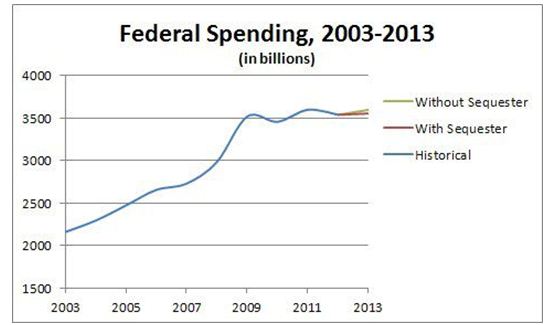
- All the clamor might lead us to believe that, even if this situation isn’t ideal, at least we’re headed towards curbing government’s excessive spending. But the $85 billion sequester cut is less than one tenth of what was agreed upon in August 2011. Washington’s spending problem is virtually the same as it ever was:
The heart of the problem:
- Discretionary programs rarely get cut because it’s generally not in a politicians’ best interest. For every lawmaker who is attempting to make cuts to a program, there’s another who is championing its cause, supported by a lobby of constituents who benefit by it.
- We rarely see groups demonstrate their gratitude when politicians make tough budget decisions. But when programs are cut there are always angry factions. Unpopular politicians don’t get reelected.
- Deal making (“I’ll save your program if you vote to save mine”) is rampant.
- There’s no repercussion to politicians when budgets aren’t passed or if we spend more than we have. The government simply borrows more or the Federal Reserve prints more money to pay the added expense. The House and Senate have not agreed on a budget since 2009.
We need to focus on solutions to the root problem. If Congress’ pay, future pensions and/or ability to run for reelection were tied to passing balanced budgets, lawmakers would have a much greater incentive to be judicious about spending.
If Americans were no longer sidetracked by partisan battles, legislators would quickly learn that there was no place to pass the blame.
Please share your thoughts (anonymously if you’d like) here.
Wisdom
“Everyone is entitled to his own opinion, but not to his own facts.” – Daniel Patrick Moynihan
Do we have freedom of political thought?
Do we have freedom of political thought in America? Your first reaction may be, ‘Of course! What a silly question!’
But do we? Or has our thinking become narrowed by the limited choices presented to us?
If you’re like me, you’re discouraged by an ever-expanding chasm between left wing and right wing thinking.
You don’t always agree with your party’s politicians or with certain portions of your party’s platform, but don’t speak out about them. Endorsing the lesser of two evils seems to be the only alternative.
Perhaps you even feel politically homeless, unable to embrace either party as your own.
You see the problems in America escalating with no solution in sight. You may have even begun to think voting is a waste of time.
The good news is that most Americans would agree on one thing: that our American way of life is worth fighting for.
In the United States we’re given a left vs. right choice that theoretically makes up the entire range of political opinion. But it doesn’t. Instead we are funneled into two-dimensional thinking that eliminates a whole spectrum of thought.
Instead of focusing on whether ‘our’ side is correct on particular issues, perhaps it’s time to examine the failings of our two-party system as a whole. While we’ve been occupied with topics of the moment such as “fiscal cliffs,” gun control and abortion, we’ve lost sight of some of the basic problems that mar our system.
Perhaps the problem isn’t that people have become too liberal or too conservative. After all, our nation was conceived in the name of freedom. The laws of our land were designed to allow us all to enjoy our own manner of living and our own ways of thinking, as long as we hurt no others.
So why have our differences in lifestyle become more problematic than ever before? Why so much animosity today?
Because when government becomes the arbiter of morality, and is given the task of solving all society’s problems, they must encroach on our lives, whether it’s in our bedroom, in our pocketbook, or in our pursuit of happiness. Our differences become more than a disagreement. They become a fight for our way of life.
As this series will illustrate, when government focuses on a strictly limited agenda that curtails the political power of bureaucrats, big business and special interests, while enforcing personal liberty, tolerance and justice for all, many of the issues that seem to have become unsolvable suddenly become quite clear.
Once, “liberal” meant open-minded. “Conservative” meant restrained. Despite the rhetoric, we must recognize that neither of our political parties are truly either of these things today.
Freedom of thought gives us a greater ability to look at both parties critically. When Americans stop feeling compelled to strictly defend one platform or another, we have the ability to support messages that make sense whether they come from either party, or neither of them. Political candidates can then feel less afraid about being autonomous, and can assert independence from rigid party dogma.
To discern why government seems to be failing us in so many ways, we must take a giant step outside partisan biases and look at the big picture. We need to be scrupulously impartial, logical and consistent in our arguments. It’s harder than we think.
We get the message from multiple sources that we should be fearful of freedom. But perhaps what we should fear more is a government which, by focusing on partisan priorities, is eroding our civil liberties from both the left and the right.
If you believe that you already consider political issues with an open mind, this series will test that conclusion.
 Free to Think